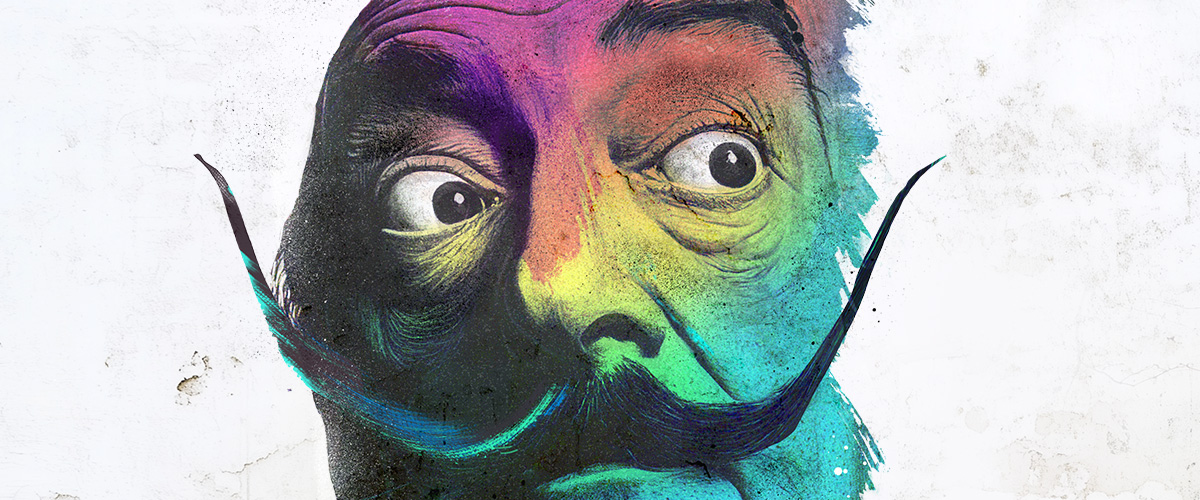
The Salvador Dalí Museum is the permanent home of the world's most comprehensive collection of the renowned Spanish artist's work. Compiled by the A. Reynolds Morse and Eleanor Morse over a 45-year period, it is celebrated for its 96 oil paintings.

With oils spanning from 1917 through 1970, the collection provides an excellent overview of Dalí's major themes and symbols. Characterized by its diversity, it includes the Impressionist and Cubist styles of his early period, abstract work from his transition to Surrealism, the famous surrealist canvases for which he is best known, and examples of his preoccupation with religion and science during his classic period.

In addition to the 96 oil paintings, the collection includes over 100 watercolors and drawings, 1,300 graphics, photographs, sculptures and objects d'art, and an extensive archival library. Periodic rotations of the collection and special exhibitions allow museum goers to view new work on repeat visits.

Dalí's own museum - the Teatre-Museu Dalí; is located in Figueres, Spain.


Collection Highlights

Self Portrait (Figueres) (1921)

This self-portrait, painted about 1921 indicates that Dalí's style had become less impressionistic and subject...
Self Portrait (Figueres), Dali
Cadaqués (1923)

Salvador Dalí embraced his Mediterranean homeland, painting it repeatedly throughout his career...
Cadaques, Dali
Portrait of My Sister (1923)

Portrait of My Sister, Dali
Girl with Curls (1926)

This girl originated in childhood fantasies about a fictional Russian girl whom Dali nicknamed “Galuchka...
Girl with Curls, Dali
Girl's Back (1926)

Girl's Back, Dali
Basket of Bread (1926)

This small panel furnishes proof that in 1926 Dali's formative years were drawing to a close. It exemplifies...
Basket of Bread, Dali
The Average Bureaucrat (1930)

As a Surrealist, Dalí had an aversion to bureaucrats. His father, who had expelled Dalí from the family hom,...
The Average Bureaucrat, Dali
Oeufs sur le Plat sans le Plat (1932)

Translated as Eggs on a Plate Without the Plate, this painting was inspired by an "intra-uterine memory." According...
Oeufs sur le Plat sans le Plat, Dali
Portrait of Gala (1932-1933)

Portrait of Gala
Archeological Reminiscence of Millet's "Angelus" (1933-1935)

Dalí had a fascination with the popular painting by Jean-Francois Millet called The Angelus. This fascination developed...
Archeological Reminiscence of Millet's
Puzzle of Autumn (1935)

Puzzle of Autumn, Dali
Paranonia (1935-1936)

Paranonia
Three Young Surrealist Women Holding in Their Arms the Skins of an Orchestra (1936)

In this surrealist landscape Dalí has transplanted the black cliffs of Cape Creus to a sandy beach. Dalí has also...
Three Young Surrealist Women Holding in Their Arms the Skins of an Orchestra , Dali
Old Age, Adolescence, Infancy (The Three Ages) (1940)

Dalí uses double images to create the allegorical faces of Old Age, Adolescence, and Infancy. Glimpses...
Old Age, Adolescence, Infancy (The Three Ages), Dali
Daddy Longlegs of the Evening--Hope! (1940)

Daddy Longlegs was the first painting the Morses bought for their collection in 1942. It was a Dalínian...
Daddy Longlegs of the Evening--Hope!, Dali
Slave Market with the Disappearing Bust of Voltaire (1940)

This work is an example of the instantaneous paranoiac-critical hallucinations Dalí received on the...
Slave Market with the Disappearing Bust of Voltaire
Geopoliticus Child Watching the Birth of the New Man (1943)

This painting initiates Dalí's classic period. While working on this painting, the artist jotted down some notes...
Geopoliticus Child Watching the Birth of the New Man, Dali
The Disintegration of the Persistence of Memory (1952-1954)

In this work of 1954, Dalí reinterprets his popular 1931 painting entitled The Persistence of Memory in order...
The Disintegration of the Persistence of Memory, Dali
Nature Morte Vivanteb (Still Life--Fast Moving) (1956)

Nature Morte Vivante, painted in 1956, is Dalí's sixth masterwork. This painting, which Dalí translated as...
Nature Morte Vivante (Still Life--Fast Moving), Dali
Velázquez Painting the Infanta Marguerita with the Lights and Shadows of His Own Glory (1958)

In anticipation of the 300th anniversary of the death of Velazquez, one of Spain's greatest painters, Dalí painted...
Velazquez Painting the Infanta Marguerita with the Lights and Shadows of His Own Glory, Dali
The Discovery of America by Christopher Columbus (1958-1959)

Dalí's tenth masterwork is The Discovery of America, completed in 1959. This work, which is almost 14 feet tall...
Discovery of America by Christopher Columbus, Dali
The Ecumenical Council (1960)

This canvas honors Pope John XXIII for uniting the churches through the Ecumenical Council. The coronation of...
The Ecumenical Council, Dali
Galacidalacidesoxiribunucleicacid (Homage to Crick and Watson) (1963)

This unusually titled work is called Galacidalacidesoxiribunucleicacid, and subtitled “Homage to Crick and Watson."...
Galacidalacidesoxiribunucleicacid (Homage to Crick and Watson), Dali
Portrait of My Dead Brother (1963)

This unusual painting refers to one of the key stories in the artist’s life, his relationship with his dead brother...
Portrait of My Dead Brother, Dali
The Hallucinogenic Toreador (1969-1970)

Dalí conceived this painting while in an art supply store in 1968. In the body of Venus, on a box of Venus pencils,...
The Hallucinogenic Toreador, Dali
Gala Contemplating the Mediterranean Sea which at Twenty Meters Becomes the Portrait of Abraham Lincoln -- Homage to Rothko (Second Version) (1976)

In 1974 began work on the monumental, first version of Gala Contemplating the Mediterranean Sea...
Gala Contemplating the Mediterranean Sea which at Twenty Meters Becomes the Portrait of Abraham Lincoln--Homage to Rothko (Second Version), Dali